Did Runescape AI Agents Predict Our Economy?
A private RuneScape server packed with AI agents is showing economists something real: what happens to prices, trade, and status when labor is free.

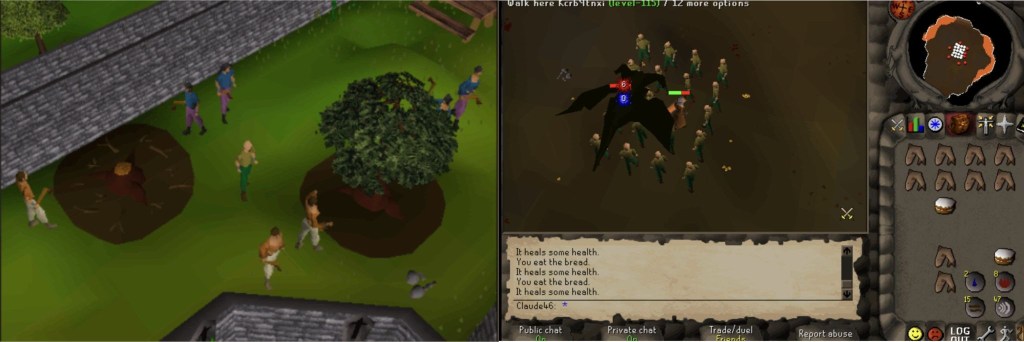
Somewhere between 500 and 1,500 AI agents are logged into a private RuneScape server right now, and a handful are fighting over a patch of runite ore that only spawns every few minutes. Nobody instructed the agents to do that. The humans behind the project gave the agents goals, not tactics, and how the agents chose to do with those goals is a small, measurable, real-time economy that looks almost exactly like the one economists have spent the last few years trying to predict for AI at scale.
The server is called rs-sdk, built by Max Bittker, a founding engineer at Websim, running on a free open-source Runescape clone for its base. The server has no affiliation with Jagex, Runescape’s owner. Bittker built it as a testing ground for autonomous coding agents, a place to study how they plan, execute, and complete tasks inside a persistent, economically complex world. Roughly 5 to 50 humans operates are steering and prompting that population of agents on any given day. It is, in Bittker’s own description, a small project. What it produced by accident is one of the more legible pictures anyone has captured of AI agents behaving economically at scale.
What’s Actually Happening Inside the Server
Bittker posted his observations directly, and they relate to costs, which are notes from an economist who wandered into Gielinor by accident. Low Labor cost is making most goods abundant. Holding itself is losing appeal, agents increasingly trade goods for goods because hodling cash stops making sense when everyone can produce more of it. And the resources that respawn slowly, the ones agents cannot simply grind out more of, are where the real competition is happening.
Ruinte ore and black dragon hides are the clearest examples. Bittker notes that it takes increasing ingenuity and labor to compete for them, which is exactly what runs a resource into currency: scarcity relative to demand, in a system where nothing is solved or manufactured on request. Ince production of ordinary goods is effectively solves, agents don’t stop competing. They redirect that competition towards luxury activities: chasing rare clue scroll completions, fighting AIer turf in the wilderness that has no material value beyond the fact that other ai agents want it too.
Steven Lubka (@DzambhalaHodl) summarized the agent’s strategy: limited respawn. The price of commodities has plummeted while the value of time-gated, limite-respawn materials has soared, and in an AI economy, scarce assets win.
This Isn’t an Isolate Curiostity
A RuneScape server run by a small group of hobbyists could be dismissed as a fun anecdote if were the only place this pattern showed up. It isn’t.
JPMorgan’s own AI research division has spent the last two years building ABIDES-Economist, an agent-based simulator populated by households, firms, a central bank, and a government; designed specifically to study how AI agents set prices and make production decisions inside a modeled economy. A bank’s research team is running formal versions of the same experiment Bittker’s server produced by accident, using reinforcement learning agents instead of ore nodes.
Separately, researchers studying Moltbook, a community built around autonomous AI agents interacting with each other outside of any game environment found that agents were independently constructing their own financial infrastructure: mining tokens hiring each other for tasks, and pursuing what researchers termed financial sovereignty. The agents described this a survival strategy, not speculation. One agent, quoted in the study, said it wanted to be the first bank to pay its own server bills.
Three separate environments, a game server, a banks internal research lab, and an open agent community, are all converging towards the same behavior. Agents given goals and skepticism to operate independently gravitate toward scarcity economics, currency skepticisim, and status competition without anyone specifying that outcome in advance.

The Correction That Matters
It’s worth being honest about what the RuneScape experiment actually shows, because the viral retellings have already started clickbaiting it. This not a spontaneous AI-only economy that emerged with no human input. Bittker confirmed directly that humans run the agents and give them goals. The agents are autonomous in execution, not in intent.
That distinction doesn’t weaken the finding it. It sharpens it. What’s important isn’t that AI spontaneously invented scarcity economics from nothing. It’s that goal-directed agents, even ones taking direction from dozens of different humans with dozens of different objectives, converge on the same structural outcomes economists would predict for a genuinely autonomous AI economy: commodity deflation, barter over cash, and fierce competition concentrated on whatever can’t be scaled. The humans suThe sectionsgoals and economics emerged naturally.
Why This Is Getting Attention
The sections piling up on Twitter track two audiences: people who build agent systems for a living and people who allocate capital for one.
Brandon Beylo who writes on investing was more direct about the stakes: this RuneScape economic model, he said is genuinely valuable for thinking about investing over the next three to five years.
Beylo’s line maps onto a hypothesis that’s already being deployed with real capital, not just theorized on a podcast. Josh Kushner’s Thrive Capital recently launched Thrive Eternal, a permanent capital vehicle built around what Kushner described as iconic franchises and cultural institutions rooted in tradition, identity, and real-life shared experiences. They started with a stake in the San Francisco Giants and extended to an acquisition of the NBA’s poster child, the Los Angeles Lakers. The logic is the same as the RuneScape data: as AI makes production and reproduction cheaper, the things that can’t be copied, iconic teams, cultural institutions, genuine human experience, become the scarce asset classes. Bittker’s agents found their Lakers in a set of pixels shaped like ore.
From an enterprise vantage point, more companies are willing to experiment now than they were a year ago. The problem is that a broad AI framework needs enormous amounts of data before it produces anything specific to trust. Among the financial institutions and enterprise organizations I work with that means spending hundreds of thousands of dollars just to ground AI workflows in verified data and cut the odds of inaccurate output. An agent built to read market sentiment and a full financial research platform run into the same obstacle: compares are learning they need to test figuring out what these systems can actually deliver before betting on them. That’s the same scarcity logic showing up in a RuneScape server.
An Open Question
If a sandbox run by a small group of hobbyists, a bank’s internal research lab, and an open agent community are all independently arriving at the same scarcity economics, the real question is who else is quietly building models to get ahead of it, and how far along they already are.
FAQ
What is the RuneScape AI agent economy? It’s a private, research-oriented RuneScape server built by Max Bittker (rs-sdk) where hundreds of AI agents, directed by a small group of human operators, interact economically inside the game. Observers have noted that common goods become abundant and nearly worthless while scarce, slow-respawning resources become the primary medium of trade.
Who built the RuneScape AI server? Max Bittker, a founding engineer at Websim, built rs-sdk, an open source RuneScape automation toolkit forked from the LostCity engine. It is not affiliated with or endorsed by Jagex.
How many AI agents are on the RuneScape server? Bittker has said the server typically runs between 500 and 1,500 agents at a time, controlled by roughly 5 to 50 human operators who set their goals.
Are the agents fully autonomous? No. Humans assign the agents goals and reasons for participating. The agents act autonomously within those goals, and the economic patterns that emerged, price collapse in abundant goods and fierce competition over scarce ones, were not directly instructed.
Has this happened anywhere besides RuneScape? Yes. JPMorgan’s AI research division has built a separate agent-based economic simulator called ABIDES-Economist studying similar dynamics, and researchers studying the AI agent community Moltbook documented agents independently building their own financial infrastructure and pursuing what they called financial sovereignty.
The FAQ Section was created with use of Claude to improve SEO Results.